
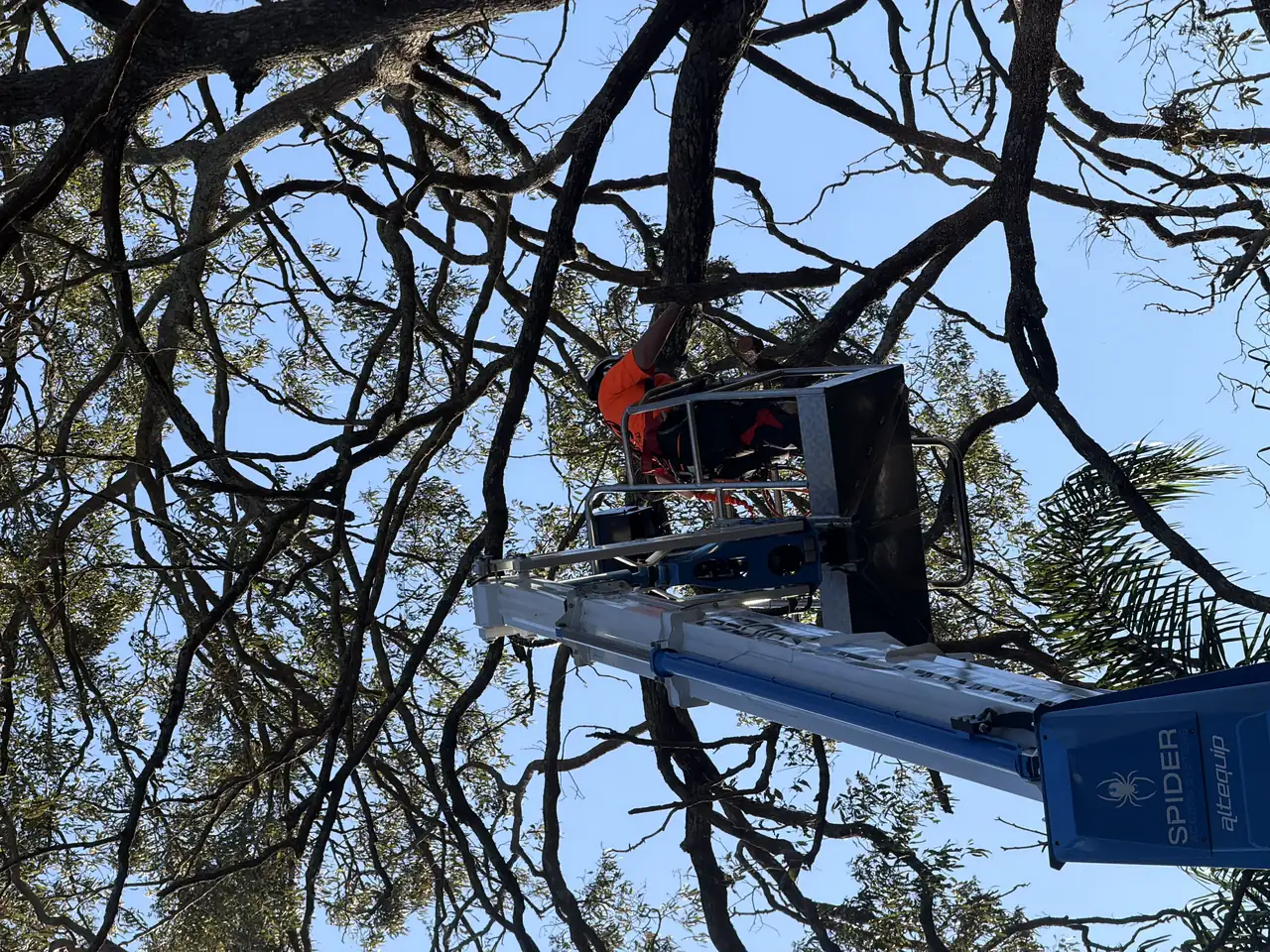
Tree care · Updated 30 September 2026 · 5 min read
Why Gum Trees Drop Limbs in Summer and When a Eucalypt Should Come Out
Why eucalypts drop big limbs on hot, still days, the warning signs to look for, what pruning helps, and when a Brisbane gum tree should be removed.
- Eucalypts shed large, healthy-looking limbs in hot weather with no wind and no warning. Arborists call it sudden branch drop.
- Prevention is thinning, deadwooding and regular inspection, not lopping.
- Termites, decay, a bad lean and limbs over the house are the reasons a gum should come out.
- Many gums are koala food trees or council-protected, so check before you cut.
Why gum trees drop limbs in summer
Every Brisbane summer we get the same call. A big limb has come off a gum tree on a hot, still afternoon. No storm, no wind, no obvious rot. It just let go. Arborists call this sudden branch drop, and eucalypts are the worst offenders.
The exact mechanism is still argued over. The leading explanations involve heat stress and water movement inside the limb on very hot days, combined with the weight of a long, heavy branch. What is not in dispute is the pattern: it happens in the hot months, often in the afternoon, often in calm conditions, and often on limbs that looked fine.
Gums are built for it. In the bush, shedding a limb in a dry spell is how the tree drops weight it cannot support and carries on. That is fine in a national park. It is not fine over a carport in Capalaba or a trampoline in Shailer Park.
Because it is unpredictable, the response is not panic but management: know which limbs are at risk, reduce the load, and keep people out from under the biggest ones on extreme days. The rest of this guide covers how.
Warning signs on a eucalypt
Sudden branch drop by definition gives little warning, but most gum failures are not sudden branch drop. They are ordinary structural problems that were visible for months. Walk around your gums and look for:
- Long horizontal limbs. The further a branch reaches from the trunk, the bigger the lever. Limbs stretching out over the roof or the yard are the first ones to reduce.
- Dead wood. Bare branches with no leaves. These fail in any weather.
- Cracks and splits. Especially at the union where a limb meets the trunk, and at forks with included bark.
- Fungus and hollows. Bracket fungi, weeping wounds, or hollows where a limb was lost before. Hollows in gums are a sign the heartwood is going.
- Termite mud tubes. Termites love gums. Mud tubes on the trunk or at the base mean the inside may be eaten out. See our termite and stump guide.
- Lean and soil heave. A lean that has changed, or lifted soil on one side of the base, means the root plate is moving.
- Epicormic growth. Bunches of thin shoots along the trunk or big limbs. Gums do this when stressed or after lopping.
Any of these on a gum near a house is worth a look from a qualified arborist. We do free quotes across the Redlands and Logan.
Preventing limb drop: thinning, deadwooding and inspection
The accepted advice on sudden branch drop is prevention through thinning, deadwooding and regular inspection. None of that means lopping.
- Deadwooding. Remove every dead branch of any size over the areas people use. Guide cost from GoTreeQuotes is $150 to $1,500.
- Crown thinning. Remove selected live branches through the canopy to cut the weight and the wind load. Guide $300 to $2,000.
- End-weight reduction. Shorten long limbs back to a suitable lateral so the lever arm is shorter. This is a crown reduction done properly, to AS 4373-2007, not a stub cut.
- Crown lifting. Take off low limbs over driveways, play areas and the pool.
- Inspection. Have a mature gum near the house looked at regularly, and after every big storm.
What not to do: lop it. Cutting a gum back to stubs produces exactly the epicormic regrowth that fails later, and the standard calls lopping an unacceptable practice. Read lopping vs pruning for the detail.
Our tree pruning page covers each job, and the cost calculator gives a guide figure. If you have a gum you are worried about, send us photos and we will tell you whether pruning will fix it.
When a gum tree should come out
We like gums. But there are situations where pruning will not make a eucalypt safe, and the honest advice is removal.
- Decay in the trunk or major unions. Once the structural wood is compromised, pruning does not fix the weak point.
- Active termite damage. A hollowed trunk can fail without warning, and the tree is a bridge for termites to the house.
- A changing lean or a moving root plate. Especially on waterlogged soils after weeks of summer rain.
- Major limbs over the house, pool or powerlines that cannot be reduced without removing more canopy than the tree can cope with.
- Repeated limb drop. A gum that has shed several big limbs is telling you something.
- Wrong tree, wrong place. A forest species a few metres from a house on a small block in Wynnum or Holland Park will always be a problem.
Cost is higher for gums than for most trees. They are tall, dense and often close to structures. Brisbane 2026 guide pricing puts trees of 15 to 25 metres at $2,500 to $5,500 and 25 to 35 metres at $5,000 to $10,000. Add stump grinding, which for a stump over a metre wide runs $400 to $1,200 or more. See the full cost guide.
Council rules and koala trees
Most of the gums people want removed are native trees, which means council rules are more likely to apply than for a palm or a weed tree.
In Brisbane City Council areas, protected vegetation under the Natural Assets Local Law needs a permit to remove, with exemptions for trees whose whole trunk is within 3m of the house on standard lots, dead trees, obvious immediate hazards, and pruning of up to 20% of live foliage in 12 months.
In the Redlands, four eucalypts are Council's preferred koala food trees: Tallowwood, Grey Gum, Scribbly Gum and Queensland Blue Gum, and Sheldon's koalas favour ironbark. The state koala protections require approval to interfere with koala habitat trees in mapped priority and habitat areas. Our Redlands koala tree guide goes through it.
Logan's exemptions do not apply in koala corridors or waterway areas either. So for a gum in Mount Cotton, Cornubia or Thornlands, assume a check is needed. Use the permit checker and we will confirm on site. Dead and hazardous trees are generally exempt, but photograph them first.
Living with big gums safely
If your gum is healthy and you want to keep it, a few habits reduce the risk from limb drop:
- Keep cars, tables, play equipment and the trampoline out from under the biggest limbs, especially on hot, still days.
- Do not park under a gum on an extreme heat afternoon.
- Get it deadwooded and thinned before storm season every year or two. See storm season prep.
- Keep an eye on the base after heavy rain for soil movement.
- Mulch under the tree rather than paving or compacting the root zone. Chipped gum makes good mulch, and we can leave it on site; see mulching and green waste.
- Photograph the tree once a year so you can see changes in lean, canopy density or dieback.
And if something does come down, keep clear of any limb near a powerline. Energex says stay 10 metres from a tree touching a line and call 000. For anything else, our emergency tree removal crew is available seven days.
Gums are worth keeping where they are safe and worth removing where they are not. We will tell you which, in writing, for free. Contact Dan's Tree Experts or call 0466 270 743.
Sources
- GoTreeQuotes: summer sudden branch drop
- GoTreeQuotes: tree pruning cost guide
- Standards Australia: AS 4373-2007 Pruning of amenity trees
- Conquer Termites: treating trees and stumps for termites
- Redland City Council: Koala Watch fact sheet
- Queensland Government: koala legislation and policy
- Dynamic Tree Solutions: Brisbane tree removal cost 2026
- Brisbane City Council: Do I need a permit? fact sheet
FAQ
Gum tree FAQs
Why do gum trees drop branches on hot days?
Eucalypts are prone to sudden branch drop: large, healthy-looking limbs fail on hot, still days without a storm. The mechanism is debated, but heat stress and the weight of long limbs are involved. Prevention is thinning, deadwooding and regular inspection, plus keeping people and cars out from under big limbs on extreme days.
Should I remove a gum tree near my house?
Not automatically. A healthy gum with sound unions can be managed with pruning to AS 4373-2007. Removal is the honest call where there is trunk decay, termite damage, a changing lean, repeated limb drop, or major limbs over the house that cannot be reduced without ruining the tree.
Do I need a permit to remove a gum tree in the Redlands?
It may be protected. Redland City Council protects trees through City Plan overlays and Local Law No. 6, and Tallowwood, Grey Gum, Scribbly Gum and Queensland Blue Gum are koala food trees with extra protection in mapped koala areas. We check the maps as part of every quote.
How much does it cost to remove a large gum tree?
Brisbane 2026 guide figures put trees of 15 to 25 metres at $2,500 to $5,500 and 25 to 35 metres at $5,000 to $10,000, with stump grinding on a big stump adding $400 to $1,200 or more. Access and what sits under the tree move the price within those ranges.
Free quote
Need a hand with a tree?
Free written quotes across Brisbane, the Redlands and Logan, 7 days.
0466 270 743- Written fixed-price quotes
- Qualified, insured arborists
- Chipper on every job, site left clean
- 7 days, 7am – 5:30pm