
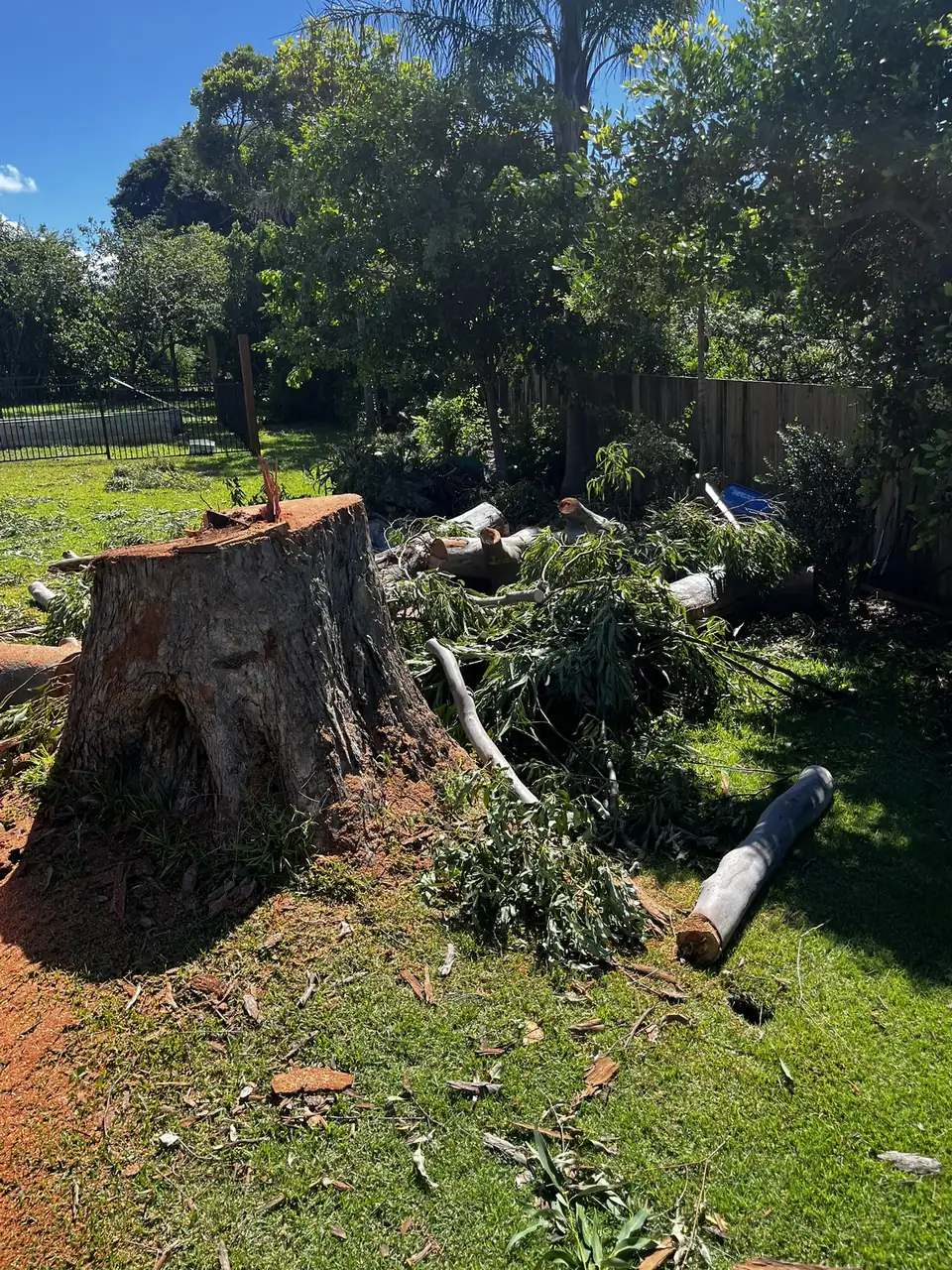
Stumps · Updated 30 September 2026 · 6 min read
Termites and Tree Stumps: Why Old Stumps Are a Risk to Brisbane Homes
Old tree stumps feed termites and give them a base to reach your house. Why stumps are a risk in Brisbane, what grinding costs, and what to do next.
- Gum trees and old stumps are prime termite food, and a stump near the house is a base for a colony to work from.
- Some insurers exclude fallen-tree damage where the tree had pre-existing termite damage.
- Brisbane guide stump grinding rates run from $80 for a small stump to $1,200 or more over a metre wide.
- Grinding removes the food source. Poisoning or leaving the stump does not.
Why old stumps attract termites
Termites eat wood. A tree stump is a large block of wood, sitting in damp soil, with a root system running underground in every direction. For a termite colony it is a perfect home: food, moisture and shelter in one place. Brisbane's warm, wet summers make it worse.
Pest controllers see it constantly. Conquer Termites notes that gum trees and stumps attract termites, and that trees and stumps in the yard are a common starting point for infestations in the house.
The process usually goes like this. A tree is removed or dies, and the stump is left. The stump starts to rot, which softens the wood and makes it easier to eat. A colony moves in, either from the soil or from an existing nest in a nearby gum. The stump becomes a satellite nest. From there, foraging termites follow roots and soil moisture towards the next food source, which is often the timber in your house, deck or fence.
The closer the stump is to the house, the shorter that journey. A stump under the deck or beside the slab is the worst case. But termites travel a long way underground, so a stump at the back fence is not safe either.
Signs of termites in a stump or tree
Termites work out of sight, so most people find them by accident. If you have old stumps or mature gums in the yard, check for these:
- Mud tubes. Pencil-width tunnels of dried mud running up the stump, the trunk, a fence post or the outside of the slab. Termites build them to stay damp and hidden.
- Soft or hollow wood. Push a screwdriver into the stump. If it goes in easily or the surface crumbles, something has been eating it.
- Mud packing in cracks. Termites plug gaps with mud. Look at splits in the stump and the base of the trunk.
- Flying termites. Swarms of winged alates on warm, humid evenings mean a mature colony nearby.
- Fungus and rot. Not termites themselves, but decaying wood is what draws them.
- Dieback in a live gum. A gum with a thinning crown and mud tubes on the trunk may be hollow inside.
Finding termites in a stump does not mean they are in the house. It does mean you should get a pest inspection, and get the stump out. We do stump grinding across the Redlands and Logan, and we will tell you if we find live termites when we grind.
The insurance problem with termite-damaged trees
There is a second reason to deal with termite-affected trees and stumps before storm season, and it is one most homeowners have not heard of.
According to Conquer Termites, some insurers exclude damage from a fallen tree where the tree had pre-existing termite damage. The argument is that the failure was foreseeable and the owner should have dealt with it.
Picture it. A big gum in Capalaba has termite mud tubes on the trunk that you never noticed. A storm in January brings it down on the roof. The assessor finds the trunk was hollowed out and the claim gets harder. That is a very expensive stump to have ignored.
We are arborists, not insurers, and every policy is different, so read yours. But the practical advice is simple:
- Have mature gums near the house inspected for termite activity and decay before storm season.
- Grind old stumps rather than leaving them.
- Photograph trees and stumps so you have a record of their condition.
- If a tree is found to be termite-damaged, remove it rather than hoping it holds. See tree removal.
The cost of a removal is a lot less than an argument over a roof.
Stump grinding cost in Brisbane (guide only)
Stump grinding is priced mainly on diameter, measured across the widest point at ground level, plus access and how many stumps there are. Brisbane 2026 guide rates:
| Stump diameter | Guide range |
|---|---|
| Under 30cm | $80 to $150 |
| 30 to 60cm | $150 to $260 |
| 60 to 100cm | $260 to $400 |
| Over 100cm | $400 to $1,200 or more |
GoTreeQuotes gives a national average of $95 per stump and a rule of thumb of the diameter in centimetres multiplied by $3. So a 50cm stump lands around $150, which matches the Brisbane table.
What moves the price:
- Access. Our grinder needs to fit through the gate. Stumps in a rear courtyard with narrow side access take longer.
- Depth. Standard grinding goes below ground level for turf. Deeper grinding for a slab, path or garden bed is extra.
- Roots. Grinding surface roots out across a lawn adds time.
- Species. Hardwood gums and ironbarks are slower than palms or camphor laurel.
- Numbers. Several stumps in one visit cost less each.
Grinding is usually cheapest when done on the same day as the removal, because the crew and gear are already there. Use the cost calculator or read the cost guide.
Grinding, digging out or poisoning: what works
There are three ways people deal with a stump. Only one of them removes the termite food source.
- Stump grinding. A machine with a spinning cutter wheel chews the stump into chips, below ground level. The bulk of the wood is gone, the big roots near the surface are cut, and the hole can be backfilled and turfed. This is what we recommend for almost every stump. See stump grinding and removal.
- Digging the whole stump out. Needed when a slab, pool or new building is going where the tree was. It leaves a large hole and costs more, but nothing is left in the ground. Usually part of a land clearing job.
- Poisoning or "stump killer". Stops regrowth on species that sucker, but the stump is still there, rotting, and rotting wood is what termites like most. It does nothing to reduce termite risk.
- Leaving it. Free today, expensive later.
Grinding does leave the deeper roots in the soil. They break down over time and termites can feed on them, so a stump grind is not a termite treatment. If you have found active termites, get a pest controller to treat the site as well. The two jobs together, grind then treat, are how you close the problem out properly.
After grinding: chips, soil and the next tree
A ground stump leaves a hole full of wood chips mixed with soil. What you do next matters.
- Remove most of the chips. A big pile of chipped stump left in the hole is still wood in damp ground. Rake out the bulk, and use it as mulch on garden beds away from the house or put it in the green waste.
- Backfill with soil. Fresh soil settles, so mound it slightly, then turf or plant.
- Watch for regrowth. Camphor laurel, Chinese elm and umbrella tree will sucker from roots. See our weed tree guide.
- Check the rest of the yard. One stump usually means others, and old gums with hollows are the same risk.
- Mind the mulch. Mulch is good for gardens, but keep any woody mulch clear of the slab and weep holes.
If you are taking the chips off site yourself, Brisbane City Council resource recovery centres charge $16 for a car or a ute and trailer load under 100kg, $26.60 for 100 to 500kg, and $131 a tonne over 500kg for green waste in 2025-26. Or we take it with us; see mulching and green waste removal.
For stumps in Alexandra Hills, Daisy Hill, Carindale or anywhere across our service area, book a free quote.
Sources
FAQ
Termites and stumps FAQs
Do tree stumps attract termites?
Yes. Rotting stumps in damp soil give termites food, moisture and shelter, and gum stumps are especially attractive. A colony in a stump can forage along roots towards the timber in a house, deck or fence. Grinding the stump removes the main food source.
How much does stump grinding cost in Brisbane?
Brisbane 2026 guide rates are $80 to $150 for stumps under 30cm, $150 to $260 for 30 to 60cm, $260 to $400 for 60 to 100cm, and $400 to $1,200 or more over a metre. The national average is around $95 per stump. Access, depth and stump count move the price.
Does stump grinding get rid of termites?
It removes the stump, which is the main food source, but it is not a termite treatment. Deeper roots stay in the soil and a colony can still be present nearby. If you find live termites, have a pest controller treat the site as well as getting the stump ground.
Will insurance cover a termite-damaged tree that falls on my house?
Not always. Some insurers exclude fallen-tree damage where the tree had pre-existing termite damage. Policies vary, so check yours. The safe approach is to have termite-affected trees and stumps inspected and removed before storm season, and to keep photos of tree condition.
Free quote
Need a hand with a tree?
Free written quotes across Brisbane, the Redlands and Logan, 7 days.
0466 270 743- Written fixed-price quotes
- Qualified, insured arborists
- Chipper on every job, site left clean
- 7 days, 7am – 5:30pm